Friday, February 19, 2010
material Contravention of CDP voted by County Council
According to a piece in the Irish Times, "COUNCILLORS IN Co Louth have voted to materially contravene the county development plan to grant permission for a supermarket on a greenfield site on the outskirts of Ardee near a link road with the M1 motorway." Curiously the councillors decided to go ahead with this despite the fact that the impact on Ardee traders has not been assesssed, there is no public transport option (the fact that people already walk along the hard shoulder of the link road is an accident waiting to happen); the Eastern Regional Fisheries Board pointed out that the impact on the local river was inadequate and that the treatment centre must be upgraded (not much chance of that in the next few years!) Dearey (GP) and Nash (Lab) were the only councillors to oppose the proposal. In an extraordianry assertion, Jim Lennon (FG), the proposer, stated that it was just what Ardee needed!!! (or was it just what Jim needed?)

Monday, February 15, 2010
The troubled Quinn Group is once again under fire over the controversial gas fired power plant at Toomes near Louth Village following an major explosion at a similar plant in upstate New York which, according to the Argus, "was the scene of a massive explosion last Sunday which left 50 feared dead". In the event hundreds were injured but thankfully there were only five fatalities. According to an item in NewsTime, "There are so many unanswered questions: What led to this disaster? What were the contributing factors? Could anything have been done to prevent it?" (State Governor) Rell said. "These are the questions that we must answer now, not only for the sake of the victims and their families but to avoid tragedies like this in the future."
These same questions equally apply to the Toomes plant, which may be at even greater risk due to the enclosed hollow where it is located. Furthermore there are human dwellings and a national school within a few hundred metres of this plant. Given the farcical testimony from the Fire Chief at the oral hearing, who was unable to explain how he would deal with a fire on the site if an explosion damaged the 5000 litre fire water storage tank, and the complacent attitude of the HSA representative, all approvals for this plant should be suspended pending a safety review.
It is interesting to note that the Quinn Group indicated during the oral hearing that it had no plans for further developments in the area, and indeed the conditions imposed by ABP would appear to reflect the boards concerns in this area. No mention was made of a second plant, in this case an Open Cycle Gas Turbine plant mentioned by Mott McDonald on their web site:
These same questions equally apply to the Toomes plant, which may be at even greater risk due to the enclosed hollow where it is located. Furthermore there are human dwellings and a national school within a few hundred metres of this plant. Given the farcical testimony from the Fire Chief at the oral hearing, who was unable to explain how he would deal with a fire on the site if an explosion damaged the 5000 litre fire water storage tank, and the complacent attitude of the HSA representative, all approvals for this plant should be suspended pending a safety review.
It is interesting to note that the Quinn Group indicated during the oral hearing that it had no plans for further developments in the area, and indeed the conditions imposed by ABP would appear to reflect the boards concerns in this area. No mention was made of a second plant, in this case an Open Cycle Gas Turbine plant mentioned by Mott McDonald on their web site:
"2007 MMP completed the feasibility studies, technical studies, Eirgrid application, the Environmental Impact assessment, tender documents and planning application for the Phase 1 450MW CCGT at Toomes in Louth. The Client was Quinn Energy.
2007 MMP completed the feasibility studies, technical studies, Eirgrid application, the Environmental Impact assessment and will soon submit the planning application for a 180MW OCGT also at Toomes in Louth. The Client is confidential."
Could it be that the second client is also Quinn, contrary to what was suggested at the oral hearing. In many other matters, notably its dealings with Anglo Irish Bank, Quinn has continued to refuse to fully disclose its exposure according to newspaper reports, to the extent that "Mr Tolan (CEO VHI) called for the full extent of Mr Quinn’s losses on Anglo to be disclosed, saying that they “should be in the public domain” as they were “relevant for people who buy their products”.
Friday, January 22, 2010
Planning Matters
We have had a number of significant planning decisions in recent months. The first was the decision by the Dundalk to refuse permission for several houses at Soldier's Point - reference 0910. This site has had an extended history and the council documents in its regard make instructive reading, especially the Planner's Report. The environmental study, carried out by a Fiona Doris (apparently a botonist) seems to have been particularly deficient.

Extract from planners report
The applicant has now appealed the councils decision to An Bord Planeala...
Another application that the council refused is of similar interest. In this case the proposal was to build a house on what remains of Ardee Bog, a pNHA (proposed Natural Heritage Area). The application, 09756, was refused for this reason, and also because it is in a flood plane, and is at odds with CDP zoning. It is interesting to reflect how times have changed - the council allowed a major infilling operation several years ago to facilitate a football pitch!

The infilled football pitch is in the centre of the brown bog area.
While these decisions may be bad news for the developers concerned, they are good news for Louth's long-suffering environment!

Extract from planners report
The applicant has now appealed the councils decision to An Bord Planeala...
Another application that the council refused is of similar interest. In this case the proposal was to build a house on what remains of Ardee Bog, a pNHA (proposed Natural Heritage Area). The application, 09756, was refused for this reason, and also because it is in a flood plane, and is at odds with CDP zoning. It is interesting to reflect how times have changed - the council allowed a major infilling operation several years ago to facilitate a football pitch!

The infilled football pitch is in the centre of the brown bog area.
While these decisions may be bad news for the developers concerned, they are good news for Louth's long-suffering environment!
Monday, November 2, 2009
Flooding in Dundalk
Following heavy rainfall in Dundalk last week there were several instances of flooding. The Argus reported "RECENT torrential rainfall led to calls for flood prevention measures to be put in place, at a meeting of Dundalk Town Council last night (Tuesday). Cllr Kevin Meenan asked that ' in light of recent flooding across various points in Dundalk, what precautions are put in place to try to prevent other major floods, such as cleaning of drains?" Councillors heard that recent flooding led to extensive inspections by council staff, and where cleaning of gullies was identified as a likely cause the gullies were cleaned and left working." Generally the flooding was believed to be partly caused by blocked drains in conjunction with heavy rain, as opposed to high tides, another common cause of flooding in the past in Dundalk. Met Eireann predicts that Ireland will see higher rainfall with the risk of more flooding in the future as a consequence of global warming.
Monday, September 14, 2009
Dundalk massively over-zoned with development land
According to a report to be published by the Ministry for Local Government and the Environment, Dundalk has zoned sufficient development land for 32,970 homes zoned enough to meet demand until 2073. According to a piece in the Irish Examiner, the report suggests "there were enough houses provided for in developing regions to satisfy the market until 2031."
According to a piece in the Irish Times, this report will result in a significant change of policy in regard to zoning:
"- End rezoning of land for commercial development without taking other factors into account
- Development plans to be aligned with regional planning guidelines, spatial strategy and population demand
- Ensure local authorities carry out immediate review of development plans.
- Planning system reform to coincide with financial measures to deal with effects of property bubble.
- Planning authorities will have to include “core strategy” in plans, placing them in context of national/regional policy"
According to a piece in the Irish Times, this report will result in a significant change of policy in regard to zoning:
"- End rezoning of land for commercial development without taking other factors into account
- Development plans to be aligned with regional planning guidelines, spatial strategy and population demand
- Ensure local authorities carry out immediate review of development plans.
- Planning system reform to coincide with financial measures to deal with effects of property bubble.
- Planning authorities will have to include “core strategy” in plans, placing them in context of national/regional policy"
Thursday, July 30, 2009
Dundalk Selected for Entente Florale
According to the Argus Dundalk has been selected for the EU Entente Florale, a sort of European version of the Tity Towns. The assessment criteria for the Entente Florale are a little different though, with a much stronger emphasis on biodiversity and integrating wildlife with town life. Points are allocated as follows:
- Vegetation and Landscape 50%
- Environment 26%
- Tourism and Involvement 24%
For example in terms of landscape the judges consider: Integration into the landscape, green corridors, long term objectives, programs, plans/strategies. Quality and maintenance of natural and protected areas, and of rivers, streams, ponds, lakes and their banks.
In practice the judges were very interested in native species being planted and allowing grass verges to grow wild. The reason is because it is now widely recognised that concentrating on native species and allowing the grass and "weeds" to grow has a much bigger impact on overall biodiversity than non-native exotic species. This is because Irish invertebrates co-evolved with our native flora and so are much more productive, more invertebrates means more food and better cover for native birds and mammals. An Taisce recommends various shrub and tree species for hedge planting, and as for the native wild flowers and grasses, they Will likely colonise naturally!
Best of luck to the hardworking Dundalk team in the competition and we look forward to the assessment report!
- Vegetation and Landscape 50%
- Environment 26%
- Tourism and Involvement 24%
For example in terms of landscape the judges consider: Integration into the landscape, green corridors, long term objectives, programs, plans/strategies. Quality and maintenance of natural and protected areas, and of rivers, streams, ponds, lakes and their banks.
In practice the judges were very interested in native species being planted and allowing grass verges to grow wild. The reason is because it is now widely recognised that concentrating on native species and allowing the grass and "weeds" to grow has a much bigger impact on overall biodiversity than non-native exotic species. This is because Irish invertebrates co-evolved with our native flora and so are much more productive, more invertebrates means more food and better cover for native birds and mammals. An Taisce recommends various shrub and tree species for hedge planting, and as for the native wild flowers and grasses, they Will likely colonise naturally!
Best of luck to the hardworking Dundalk team in the competition and we look forward to the assessment report!
Tuesday, July 28, 2009
Louth Biodiveristy Action Plan
There are just two days left to make submissions to the excellent Louth Biodiveristy Action Plan published on the LCC web site. To make submissions or just send an email supporting the plan, just email brenadn.mcsherry@louthcoco.ie.
The key points of the plan are laid out in the first few paragraphs:
"This plan represents an opportunity for Louth to lead the way in sustainable development and thereby create value across all sectors of society – enhancing the quality of life for communities and creating new business opportunities.
The actions under this plan can be placed under five main objectives:
1. To create a system for the protection of local biodiversity areas
2. To integrate biodiversity and Local Authority activities
3. To raise awareness and appreciation of Louth’s natural heritage across all sections of society
4. To gather information and enhance Louth’s biodiversity
5. To monitor the effectiveness of the Biodiversity Action Plan"
A particularly impressive feature of the is the proposal to create and protect Local Biodiversity Areas. These are areas that would fall under the threshold of current designations such as Special Area of Conservation under the Habitats Directive, Special Protection Areas under the Birds Directive and Natural Heritage Areas under the Wildlife Act.
Apart from providing a wealth of information about Louth's biodiversity, the plan also lists dozens of detailed practical actions to support and protect Louth's it.
The key points of the plan are laid out in the first few paragraphs:
"This plan represents an opportunity for Louth to lead the way in sustainable development and thereby create value across all sectors of society – enhancing the quality of life for communities and creating new business opportunities.
The actions under this plan can be placed under five main objectives:
1. To create a system for the protection of local biodiversity areas
2. To integrate biodiversity and Local Authority activities
3. To raise awareness and appreciation of Louth’s natural heritage across all sections of society
4. To gather information and enhance Louth’s biodiversity
5. To monitor the effectiveness of the Biodiversity Action Plan"
A particularly impressive feature of the is the proposal to create and protect Local Biodiversity Areas. These are areas that would fall under the threshold of current designations such as Special Area of Conservation under the Habitats Directive, Special Protection Areas under the Birds Directive and Natural Heritage Areas under the Wildlife Act.
Apart from providing a wealth of information about Louth's biodiversity, the plan also lists dozens of detailed practical actions to support and protect Louth's it.
Saturday, July 18, 2009
Never Mind the Gondolas, Here’s the Flying Pine Martins!
A few years ago a Wicklow County Council meeting it was proposed to put a gondola on Blessington lake as a tourist attraction, to which County Councillor, Jim Miley, is reported to have asked who will feed the gondola? Irish public representatives are famously ignorant of Irish wildlife but this snafu was soundly beaten by recent comments by Westmeath County Councillor Newman as reported in the Westmeath Examiner of Saturday May 30th and in the Irish Times of June 18th. The Council was discussing the imposition of Special Protection Areas under the EU birds directive for the protection of birds at Glen Lough, Lough Kinale and Derragh Lough including Whooper Swan, Tufted duck, Teal, Wigeon and other species.
Councillor Newman was reported to have commented “that he had a "bellyful" these directives and with "interference" in the everyday life of good honest country people. "We are seeing species that have never been seen before in Ireland being introduced by these people," he said. "Look at the Pinemartin, the most nasty vicious bird that you have ever seen. They were never in Ireland but have been introduced," he said.”
Newman subsequently claimed that he had been misquoted and sent a letter of clarification to the Irish Times published June 20th, which includes the following statements: “I suggested that there have recently been seen in the Midlands ravens, eagles and pine martens, and that it's conceivable that all these had been introduced from other parts of this country by well-meaning environmentalists who should know better. In over 40 years in this area I had not once seen such creatures until very recently.”
Unfortunately we will be deprived of Mr Newmans expertise in Irish wildlife as he failed to get elected in the recent County Council elections.
The fact is that pine martins, a small, shy, nocturnal, cat-like mammal that lives in trees have existed in Ireland for at least 1000 years and was probably introduced by those well meaning environmentalists, the Vikings. Ravens have been here even longer and likely were among the first species to colonise Ireland after the ice age. And God know what the councillor meant in his reference to eagles, which have not been introduced to the midlands, not by well meaning environmentalists or by anyone else.
Councillor Newman was reported to have commented “that he had a "bellyful" these directives and with "interference" in the everyday life of good honest country people. "We are seeing species that have never been seen before in Ireland being introduced by these people," he said. "Look at the Pinemartin, the most nasty vicious bird that you have ever seen. They were never in Ireland but have been introduced," he said.”
Newman subsequently claimed that he had been misquoted and sent a letter of clarification to the Irish Times published June 20th, which includes the following statements: “I suggested that there have recently been seen in the Midlands ravens, eagles and pine martens, and that it's conceivable that all these had been introduced from other parts of this country by well-meaning environmentalists who should know better. In over 40 years in this area I had not once seen such creatures until very recently.”
Unfortunately we will be deprived of Mr Newmans expertise in Irish wildlife as he failed to get elected in the recent County Council elections.
The fact is that pine martins, a small, shy, nocturnal, cat-like mammal that lives in trees have existed in Ireland for at least 1000 years and was probably introduced by those well meaning environmentalists, the Vikings. Ravens have been here even longer and likely were among the first species to colonise Ireland after the ice age. And God know what the councillor meant in his reference to eagles, which have not been introduced to the midlands, not by well meaning environmentalists or by anyone else.
Wednesday, May 27, 2009
Jet skis on Louth Waterways
Jet skis are an enjoyable form of outdoor entertainment for many people, and one can indeed see the attraction of racing out on open water, riding waves and maybe doing various tricks. At the same time jet skis make a lot of noise and because they are often used on lakes and rivers where people go to enjoy the scenery and the wildlife, conflicts of interest arise. Its not much fun going for a picnic along a quiet river or lake only to find a dozen jet skis noisily churning the water and putting the wildlife to flight!
Recently we have seen an increase of Jet Ski use along the river Boyne, and now on the Castletown River in Dundalk. In both locations jet skis were observed speeding and creating significant wake, turning in tight circles, and disturbing wildlife, in particular wild birds that use the two areas for nesting. At Dundalk docks the flock of 40 odd mute swans nest in the salt marsh just adjacent to the quay wall, along with mallard and other species. The area is used by dozens of species for feeding and roosting. The use of Jet Skis in this area should therefore be in strict compliance with the Irish Jet Ski code of conduct. Specifically the item that states: “Do not exceed 5 knots within 200m of a jetty, bridge, and wharf or with 100m of a moored craft or bathing area” and “Never harass or chase wildlife“. The code of conduct also suggests, “If you see any PWC rider acting irresponsibly, call 999 or 112 and ask for the Gardai.“
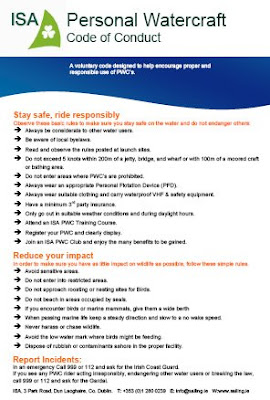
Recently we have seen an increase of Jet Ski use along the river Boyne, and now on the Castletown River in Dundalk. In both locations jet skis were observed speeding and creating significant wake, turning in tight circles, and disturbing wildlife, in particular wild birds that use the two areas for nesting. At Dundalk docks the flock of 40 odd mute swans nest in the salt marsh just adjacent to the quay wall, along with mallard and other species. The area is used by dozens of species for feeding and roosting. The use of Jet Skis in this area should therefore be in strict compliance with the Irish Jet Ski code of conduct. Specifically the item that states: “Do not exceed 5 knots within 200m of a jetty, bridge, and wharf or with 100m of a moored craft or bathing area” and “Never harass or chase wildlife“. The code of conduct also suggests, “If you see any PWC rider acting irresponsibly, call 999 or 112 and ask for the Gardai.“

The areas in question on the Boye and on the Castletown are highly sensitive areas for wildlife, being protected by both national and EU legislation (being SAC, SPA and NHAs). Clearly the entire length of the Boyne inside County Louth and beyond is protected and jet skis should, along with all other watercraft, limit their speed to less than 5 knots. Equally in that part of the Castletown that runs through Dundalk as far as Bellurgan should be have a 5-knot speed limit. The code of conduct is however only a guideline and stronger rules may be needed.
Inland waterways in Ireland are subject to a patchwork of regulations but the pertinent legislation in the context of the Boyne and Castletown are as follows:
1. It is an offence under the Wildlife Act to disturb any bird or other protected wildlife. Generally the NPWS enforce this along with the Gardai.
2. Both port areas are also regulated by their respective Harbour Masters who enforce appropriate speed limits, nominally 5 knots.
Dundalk Harbour Master: 042 9334096
Drogheda Harbour Master: 041 983 8378 http://www.droghedaport.ie/
Inland waterways in Ireland are subject to a patchwork of regulations but the pertinent legislation in the context of the Boyne and Castletown are as follows:
1. It is an offence under the Wildlife Act to disturb any bird or other protected wildlife. Generally the NPWS enforce this along with the Gardai.
2. Both port areas are also regulated by their respective Harbour Masters who enforce appropriate speed limits, nominally 5 knots.
Dundalk Harbour Master: 042 9334096
Drogheda Harbour Master: 041 983 8378 http://www.droghedaport.ie/
The Inland Waterways of Ireland may also be helpful for advice but if people do not respect the code of conduct (and to date compliance is not good) it is tough for the Harbour Master, Gardai or NPWS to enforce the law.
As a consequence the best long-term solution to this growing problem is the passage of Council Bye-Laws. This solution has been successfully adopted by many other local authorities, notably nearby progressive Fingal . The regulatory basis for this is the fact that the Marine Safety Act of 2005 (see below) empowers local authorities to enact these byelaws. Hopefully Louth’s local authorities will take action soon, before the issue become a major problem.
“6.—(1) Bye-laws may be made regulating or controlling the operation of craft or craft of a specified class by—
(a) a local authority, in waters in its functional area, other than waters referred to in paragraph (b) (except where the harbour authority concerned agrees) or paragraph (c),
(b) a harbour authority, in or on waters under its control or management, or
(c) Waterways Ireland, in or on waters under its control or management,
in respect of any or all of the following matters—
(i) the prohibition or restriction in the waters or such part of the waters specified in the bye-laws of the operation generally or for any particular purpose of craft or specified classes of craft in such places or at such times (if any) or for such periods (if any) as specified in the bye-laws—
(I) in the interests of the safety of persons using the waters generally or at certain times,
(II) to prevent nuisance to or injury to persons or damage to watercraft or other property on the waters, or
(III) subject to subsection (7), to protect—
(A) a natural heritage area, or
(B) a monument or wreck protected under the National Monuments Acts,
(ii) matters relating to launching, mooring or berthing craft,
(iii) conditions to be observed by operators of craft with regard to the waters or the adjacent area in which craft are used or launched, or (iv) maximum speed limits at which craft may be operated.”
As a consequence the best long-term solution to this growing problem is the passage of Council Bye-Laws. This solution has been successfully adopted by many other local authorities, notably nearby progressive Fingal . The regulatory basis for this is the fact that the Marine Safety Act of 2005 (see below) empowers local authorities to enact these byelaws. Hopefully Louth’s local authorities will take action soon, before the issue become a major problem.
“6.—(1) Bye-laws may be made regulating or controlling the operation of craft or craft of a specified class by—
(a) a local authority, in waters in its functional area, other than waters referred to in paragraph (b) (except where the harbour authority concerned agrees) or paragraph (c),
(b) a harbour authority, in or on waters under its control or management, or
(c) Waterways Ireland, in or on waters under its control or management,
in respect of any or all of the following matters—
(i) the prohibition or restriction in the waters or such part of the waters specified in the bye-laws of the operation generally or for any particular purpose of craft or specified classes of craft in such places or at such times (if any) or for such periods (if any) as specified in the bye-laws—
(I) in the interests of the safety of persons using the waters generally or at certain times,
(II) to prevent nuisance to or injury to persons or damage to watercraft or other property on the waters, or
(III) subject to subsection (7), to protect—
(A) a natural heritage area, or
(B) a monument or wreck protected under the National Monuments Acts,
(ii) matters relating to launching, mooring or berthing craft,
(iii) conditions to be observed by operators of craft with regard to the waters or the adjacent area in which craft are used or launched, or (iv) maximum speed limits at which craft may be operated.”
Sunday, May 10, 2009
More Poisonings
The lambing season should be coming to an end now yet the apparent national spate of poisoning continues. Framers put out meat or carrion bated with poison to kill foxes who prey on their lambs. The farmers are probably also targeting hooded crows and magpies, since it is widely believed that these species also kill newborn lambs (the evidence for this is scant - in one study (Houston, Report on Hooded Crows and Hill Farming in Argyll, Dept of Forestry and Natural Resources, Edinburgh University, 1968) it was found that about 1 in 1700 lambs were killed by crows. In lowland areas the number is doubtless lower.) Poison is also put out to prevent grey crows from eating recently sown grain (see below).

Buzzard
However the big problem with the indescriminate use of baited meat is that it will also kill any other species that eats it, particularly birds of prey such as the recently returned buzzard. This is proving to be a major problem with the reintroduction of the white-tailed eagle in Kerry and the golden eagle in Donegal. Click here for the petition to regulate the use of poison.
Closer to home, poisoned buzzards were found near Knockbridge, County Louth last week. According to a piece in the Irish Times, "EIGHT RARE buzzards have been killed in suspected poisoning incidents in the northeast in the last two months. The National Parks Wildlife Service (NPWS) said yesterday it was investigating the discovery of buzzard carcasses on farmlands in north Dublin, Louth and Meath. The broad-winged birds of prey have only recently re-established themselves in Ireland after becoming extinct in the early 20th century through poisoning and hunting." According the Dr Maurice Eakin of the NPWS, "the true number of buzzards being poisoned may be far higher, as birds often retreat to secluded spots to die after consuming contaminated food and their deaths may go unnoticed". The article continues, "Experts believe the buzzards may be consuming poisoned bait intended for grey crows which are known to eat recently-sown grain."
Friday, May 1, 2009
Congratulations Annette!
In an unusual story the NPWS reports a prosecution for the poisoning of birds in nearby county Meath: "The Minister for the Environment, Heritage and Local Government John Gormley T.D. has today (30/4/2009) welcomed the successful outcome to a prosecution taken by the National Parks & Wildlife Service (NPWS) of his Department in Navan District Court on Wednesday 22nd of April 09.
In November 07, Conservation Ranger Annette Lynch investigated a complaint of dying rooks in a field at Headfort Demesne. She found dead and dying rooks and bread laced with a blue substance in a recently tilled field. As she collected the rooks and bait she was challenged by a man, who appeared to be the landowner. When she identified herself and told him what she was doing he stated that he was not the landowner, had no interest in the land and refused to give his name and address. She took his registration number and traced it to defendant. She brought the rooks and bait to the University Veterinary Hospital, UCD for analysis."
This recalls a similar story some time ago involving the destruction of a rookerie in which the Louth Ranger, Kieran Buckley, successfully brought a case against a Louth resident, the conviction being upheld on appeal with a reduction in the fine.
Hopefully this zealon the part of NPWS rangers will spread to the rest of the country and we wil get successful prosecutions of the individuals responsible for poisoning White-tailed Eagles in Kerry and Golden Eagles in Donegal. To support this see the petition in this link.
In November 07, Conservation Ranger Annette Lynch investigated a complaint of dying rooks in a field at Headfort Demesne. She found dead and dying rooks and bread laced with a blue substance in a recently tilled field. As she collected the rooks and bait she was challenged by a man, who appeared to be the landowner. When she identified herself and told him what she was doing he stated that he was not the landowner, had no interest in the land and refused to give his name and address. She took his registration number and traced it to defendant. She brought the rooks and bait to the University Veterinary Hospital, UCD for analysis."
This recalls a similar story some time ago involving the destruction of a rookerie in which the Louth Ranger, Kieran Buckley, successfully brought a case against a Louth resident, the conviction being upheld on appeal with a reduction in the fine.
Hopefully this zealon the part of NPWS rangers will spread to the rest of the country and we wil get successful prosecutions of the individuals responsible for poisoning White-tailed Eagles in Kerry and Golden Eagles in Donegal. To support this see the petition in this link.
Friday, April 10, 2009
Floodplains for Development?
According to the Fourth Assessment Report of the UN International Panel on Climate Change, sea levels will rise by between 18 cm to 59 cm by 2100, however this estimate is limited to the thermal expansion of water and only gives limited consideration to the effect Antarctic and Greenland ice sheets melting.

Sea level rise over the last 150 years
However a recent climate change conference in Copenhagen, covered in the New Scientist , warns that the currently observed rise of 3mm per year is far above what was predicted in the TAR:
"Because modelling how the Greenland and Antarctic ice sheets will react to rising temperatures is fiendishly complicated, the IPCC did not include either in its estimate. It's no small omission: the Greenland ice cap, the smaller and so far less stable of the two, holds enough water that if it all melted, it would raise sea levels by 6 metres on average across the globe."
According to John Church of the Centre for Australian Weather and Climate Research, "By 2100, sea levels could be 1 metre or more above current levels".
Presumably responding to this, FG Cllr Eamonn O'Boyle warned in last weeks Argus that "a rise of one metre or more in global sea levels would be quite disastrous in itself, as all low-lying areas such as most of Dundalk, would be threatened by catastrophic flooding if this recent authoritative prediction materialises."
Cllr O'Boyle's solution is to enable a local developer to raise the dykes between Soldiers Point and Blackrock by 2 metres; in exchange the developer would be granted permission to develop the floodplain for housing and other uses.
The Independent newspaper notes that "Britain's Environment Agency was apparently unique when it discarded the IPCC's 2007 advice as flawed. Based on its own estimates, it is planning flood defences for 2100 on the basis of a one-metre rise in sea levels – with a "worst-case scenario" of 2.7 metres."
Countering Cllr O'Boyle's comments, Paraic McKevitt, a County Council candidate for the Green Party, was quoted in the same newspaper, "'Climate change and rising sea levels are very critical issues facing low lying coastal communities around Dundalk Bay. What we need is a Dundalk Bay flood protection plan and not a one-off embankment that leaves one development dry while increasing the flooding risk for everyone else," referring to the phenomenum whereby strengthening sea defences in one area can have knock-on effects on other areas.
According to the Office of Public Works the cause of past flooding events in the area has been due to rainfall swelling the rivers Ramparts, Blackwater, and Fane, as well as, or combined with, high tides and storm surges.
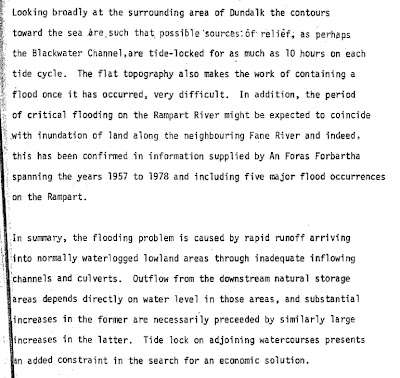
Extract from OPW report
The advice given by the OPW in regard to development on floodplains, on their special web site is unequivocal:
"Impact of flood risk on development Locating development in an area at risk from flooding can lead to property damage, human stress and hardship, problems obtaining property insurance and consequential demands for the expenditure of local authority or central government resources on flood protection works. The construction of protection works either at the time of the development, or at a later date, will incur additional costs, may not provide absolute immunity from the risk of flooding and can, if not appropriately designed, have detrimental effects on flood risk elsewhere. "
It continues:
"Impact of development on flood risk upstream In times of flood, the river flows not only through its normal channel but also along the flood plains. Any constriction of the natural flow path can 'back-up' the river and lead to increased flood levels upstream. The construction of buildings or houses, and particularly embankments for infrastructure or protection, in or across a floodplain can therefore not only put the development itself at risk of flooding, but can also increase the flood risk for land and properties upstream. The same is obviously true of any construction in, or encroachment into, the normal river channel. "
And finally,
"Impact of development of flood risk downstream Natural or agricultural land, such as forests, woodland, pastures or crop fields, is normally able to absorb a considerable proportion of any rain that falls onto it. Covering such land with buildings, tarmac (such as for parking areas or roads), or other impermeable materials significantly reduces this ability to absorb rainfall, and will lead to increased land runoff. As a result, large developments, including those away from major rivers, can increase river flows and the risk of flooding to land and property downstream. A number of smaller developments built up over a period of time can have the same effect.
Impact of tidal flood risk on development A combination of high tides, waves, high winds and surges developed from low-pressure systems can lead to extensive flooding. Current predictions of climate change indicate that the risk of flooding from the sea will increase in the future. Any area below current or predicted future peak sea levels, including areas behind existing defences that offer only a certain level of protection, are at risk from flooding in the future."
The debate on how Dundalk, and indeed County Louth, should respond to rising sea levels is joined - we look forward to following how it develops!

Sea level rise over the last 150 years
However a recent climate change conference in Copenhagen, covered in the New Scientist , warns that the currently observed rise of 3mm per year is far above what was predicted in the TAR:
"Because modelling how the Greenland and Antarctic ice sheets will react to rising temperatures is fiendishly complicated, the IPCC did not include either in its estimate. It's no small omission: the Greenland ice cap, the smaller and so far less stable of the two, holds enough water that if it all melted, it would raise sea levels by 6 metres on average across the globe."
According to John Church of the Centre for Australian Weather and Climate Research, "By 2100, sea levels could be 1 metre or more above current levels".
Presumably responding to this, FG Cllr Eamonn O'Boyle warned in last weeks Argus that "a rise of one metre or more in global sea levels would be quite disastrous in itself, as all low-lying areas such as most of Dundalk, would be threatened by catastrophic flooding if this recent authoritative prediction materialises."
Cllr O'Boyle's solution is to enable a local developer to raise the dykes between Soldiers Point and Blackrock by 2 metres; in exchange the developer would be granted permission to develop the floodplain for housing and other uses.
The Independent newspaper notes that "Britain's Environment Agency was apparently unique when it discarded the IPCC's 2007 advice as flawed. Based on its own estimates, it is planning flood defences for 2100 on the basis of a one-metre rise in sea levels – with a "worst-case scenario" of 2.7 metres."
Countering Cllr O'Boyle's comments, Paraic McKevitt, a County Council candidate for the Green Party, was quoted in the same newspaper, "'Climate change and rising sea levels are very critical issues facing low lying coastal communities around Dundalk Bay. What we need is a Dundalk Bay flood protection plan and not a one-off embankment that leaves one development dry while increasing the flooding risk for everyone else," referring to the phenomenum whereby strengthening sea defences in one area can have knock-on effects on other areas.
According to the Office of Public Works the cause of past flooding events in the area has been due to rainfall swelling the rivers Ramparts, Blackwater, and Fane, as well as, or combined with, high tides and storm surges.

Extract from OPW report
The advice given by the OPW in regard to development on floodplains, on their special web site is unequivocal:
"Impact of flood risk on development Locating development in an area at risk from flooding can lead to property damage, human stress and hardship, problems obtaining property insurance and consequential demands for the expenditure of local authority or central government resources on flood protection works. The construction of protection works either at the time of the development, or at a later date, will incur additional costs, may not provide absolute immunity from the risk of flooding and can, if not appropriately designed, have detrimental effects on flood risk elsewhere. "
It continues:
"Impact of development on flood risk upstream In times of flood, the river flows not only through its normal channel but also along the flood plains. Any constriction of the natural flow path can 'back-up' the river and lead to increased flood levels upstream. The construction of buildings or houses, and particularly embankments for infrastructure or protection, in or across a floodplain can therefore not only put the development itself at risk of flooding, but can also increase the flood risk for land and properties upstream. The same is obviously true of any construction in, or encroachment into, the normal river channel. "
And finally,
"Impact of development of flood risk downstream Natural or agricultural land, such as forests, woodland, pastures or crop fields, is normally able to absorb a considerable proportion of any rain that falls onto it. Covering such land with buildings, tarmac (such as for parking areas or roads), or other impermeable materials significantly reduces this ability to absorb rainfall, and will lead to increased land runoff. As a result, large developments, including those away from major rivers, can increase river flows and the risk of flooding to land and property downstream. A number of smaller developments built up over a period of time can have the same effect.
Impact of tidal flood risk on development A combination of high tides, waves, high winds and surges developed from low-pressure systems can lead to extensive flooding. Current predictions of climate change indicate that the risk of flooding from the sea will increase in the future. Any area below current or predicted future peak sea levels, including areas behind existing defences that offer only a certain level of protection, are at risk from flooding in the future."
The debate on how Dundalk, and indeed County Louth, should respond to rising sea levels is joined - we look forward to following how it develops!
Friday, March 27, 2009
Planning Matters
It looks like the Quinn Energy application to the EPA for an IPPC license for the operation of the proposed power plant at Toomes is once again deferred, this time up until 29th of May 2009. However persons wishing to make a submission should make it as soon as possible to the EPA.
The quarry at Bush in Cooley County Louth (Dundalk Quarry Products Ltd.) has applied to massively extend the quarry, the planning reference is 09/96 and is currently being considered by the County Council.

Quarry at Bush, Cooley.
Another application with significant consequences for Louth's environment is application reference 09/22 - this application describes "Permission for dumping and spreading of soil and stone waste for the benefit of agricultural activity and all associated site works at Stonetown Lower and Redbog, Dundalk, Co. Louth." The County Council kicked this application back for further information. The applicant was requested to provide a Biodiversity Impact Assessment and to investigate possible archaeological artifacts in the area.

Lower Stonetown and Red Bog, the area can clearly be seen as high quality from the aerial shot with superimposed OS map.
Another application sent for Further Information, this time in the south of the county along the banks of the Boyne, is 08154 (Drogheda Borough). This application proposes to develop a high quality ecological area along the north banks of the Boyne to the west of Drogheda. It is currently unclear when a decision will be made on this one...

The quarry at Bush in Cooley County Louth (Dundalk Quarry Products Ltd.) has applied to massively extend the quarry, the planning reference is 09/96 and is currently being considered by the County Council.

Quarry at Bush, Cooley.
Another application with significant consequences for Louth's environment is application reference 09/22 - this application describes "Permission for dumping and spreading of soil and stone waste for the benefit of agricultural activity and all associated site works at Stonetown Lower and Redbog, Dundalk, Co. Louth." The County Council kicked this application back for further information. The applicant was requested to provide a Biodiversity Impact Assessment and to investigate possible archaeological artifacts in the area.

Lower Stonetown and Red Bog, the area can clearly be seen as high quality from the aerial shot with superimposed OS map.
Another application sent for Further Information, this time in the south of the county along the banks of the Boyne, is 08154 (Drogheda Borough). This application proposes to develop a high quality ecological area along the north banks of the Boyne to the west of Drogheda. It is currently unclear when a decision will be made on this one...

Tuesday, March 10, 2009
Dundalk Flood Defense
In a headline article in last weeks Dundalk Leader, a proposal to raise the existing dyke by a further three metres from the Soldiers Point area to Blackrock was described. This proposal centres around the Rockview Farm and the idea is to create a large area protected from flooding that can be developed for housing, amentites, commercial development etc. According to the piece, "...the developers of Rockview Farm, a 200-acre site rezoned in 2003 may find it possible to convince Dundalk Councillors that the added protection provided to the townby a proposed upgrade to the embankment makes the plan worthwhile."
This proposal is just the latest in a series of efforts to get permission to develop this area. In 1994 an application was made to put a golf course and housing in the area. Earlier an application was made for a a business park and associated amenities. Both these and other applicaiton to develope the low-lying flood plain were refused by the County Council for the very good reason that the whole area regularly floods.

The proposal to increase the height of the dyke by 3 metres may protect the immediate area but as with many coastal developments, there is an inevitable knock-on effect: unless the dyke were to stretch all the way up the Castletown river the dyke would only move the flood plain into the centre of Dundalk!

The current thinking on such flood plains is that they should not be developed but rather left to absorb the impact of flooding events. In the south of England and in Holland, where flooding is a major problem, the current thinking is to retreat from the coast in an approach called "managed retreat". Furthermore, sea levels have been slowly rising for more than 100 years now, and with global warming, are likely to rise even further with flood events becoming more common, making the proposition to erect this dyke even less likely to be approved.
Tuesday, March 3, 2009
Vandalism
In a story reported in the Argus, Paraic McKevitt, who is rumoured to be running for the Green Party in the upcoming County Council elections, complained about a recent spate of vandalism in Greenore village: "Residents in Greenore woke last Thursday morning to find that shrubs which had been planted at the entrance to the village's famous golf course had been pulled up by vandals." This kind of petty vandalism is increasingly a feature, not just of the big towns in Louth, but increasingly the smaller towns and villages. "People have put in a lot of time and effort to try and improve the appearance of the village so it's very disappointing when something like this happens," said McKevitt.
This theme was taken up by the Lordship and Cooley Community Alert AGM in a previous item in the Dundalk Democrat: "High on the agenda is the ongoing concern on crime in the area and the continuing efforts to counteract it. Chairman of the group Kevin Conroy said "As recent reports in the press indicate, there are few signs that the problem is being resolved. Indeed, many crimes both petty and otherwise are not even being reported" he added. " Indeed failure to report and highlight these petty crimes and anti-social behavior is often the cause for their perpetrators to graduate to bigger crimes as they grow older.
We can expect more of this kind of thing as the economy continues to decline. According to a piece in the well respected OpEd News: "Around the world, law enforcement officials and sociologists are closely watching the current economy-driven rise in crime. Domestic violence, robbery, theft and murder are rising, as people fail to cope with job loss, repossession and uncertainty. In Ireland, as in the United States, economic problems are generating a fertile field for domestic violence. "
This theme was taken up by the Lordship and Cooley Community Alert AGM in a previous item in the Dundalk Democrat: "High on the agenda is the ongoing concern on crime in the area and the continuing efforts to counteract it. Chairman of the group Kevin Conroy said "As recent reports in the press indicate, there are few signs that the problem is being resolved. Indeed, many crimes both petty and otherwise are not even being reported" he added. " Indeed failure to report and highlight these petty crimes and anti-social behavior is often the cause for their perpetrators to graduate to bigger crimes as they grow older.
We can expect more of this kind of thing as the economy continues to decline. According to a piece in the well respected OpEd News: "Around the world, law enforcement officials and sociologists are closely watching the current economy-driven rise in crime. Domestic violence, robbery, theft and murder are rising, as people fail to cope with job loss, repossession and uncertainty. In Ireland, as in the United States, economic problems are generating a fertile field for domestic violence. "
Thursday, February 19, 2009
Toomes Raider Thwarted

Wet woodland at Toomes - lives to fight another day!
According to a piece in The Argus this week Quinn Energy plans to build a gas-fired power plant in the Ballykelly/Toomes area near Louth village are on hold. According to a spokesman for the troubled Quinn Group, "the company is still in the middle of the permitting system and timelines for reconstruction have been put back."
Quinn originally applied to An Bord Pleanala for planning permission under the Strategic Infrastructure Act in September 2007. After several delays and an extended oral hearing the Inspector refused permission on the grounds that the plant was a material contravention of the County Development Plan - the implication being that the Coundy Development Plan never intended such a vast commercially-run industrial facilityto be located in such a agriculturally-based rural area. However the Bord overruled their own inspector and the opinions of the many objectors and approved the plant with a large number of conditions. Approval was given in May 2008, well beyond the normal 28 week delay between application and approval.

Toomes wet meadow slated for destruction by Quinn
Quinn then applied to the Environmental Protection Agency to obtain an Integrated Pollution Prevention Control permit but the EPA inspector requested a considerable amount of further information from the applicant - delays in providing this information is the cause of the current delay.
Having said that one has to wonder if the economic downtown, the credit crunch and Quinn's well known problems in relation to the Anglo Irish Bank scandal are not adding to Quinn's problems.

Common Spotted Orchid (alba form) at Toomes
The 30 acre area in question is acknowledged by Quinn as being of very high ecological quality in the EIS that was submitted as part of the ABP application. It consists of an area of wet woodland and wet meadow, habitats that are rare in County Louth. If the project ever does go ahead the area will be substantially destroyed and County Louth's environment will be much the poorer for it. Given the many alternative brownfield sites that would be just as suitable, but probably more costly than "an auld bog", one has to wonder what the words "sustainable" mean in terms of the missions of both the EPA and An Bord Pleanala!
Friday, February 13, 2009
Eco-tourism, Wind and Wave, and Smart Logistics
These were the themes of the Sustainability Conference Hosted by the Dundalk Chamber of Commerce last Tuesday.
The first session covered opportunities for the exploitation of sustainable energy sources in the form of wind and wave. The presentation from Open Hydro was particularly impressive in terms of "big solutions", while the presentation from Cool Power addressed home solutions. The fact that we will very soon able to sell home generated energy back to the ESB was not lost on the Chamber audience.


The second session focused on integrated eco-tourism opportunities in County Louth. The first, by Brendan McSherry, Louth Heritage Officer covered, our amazing bird life; Dundalk bay has the biggest concentration of overwintering birds in the country. Yet the county, unlike every other county on the east coast, has no infrastructure for accessing nature at all! It also outlined the possibility of designating a Geopark in the Cooleys and Gullion comples. The second talk, from James Orr of Castle Espie, made a convincing case for how integrated infrastructure for nature watching can be profitable in itself, not to mention the many spinoffs from such resources. The last presentation in that session described the Marble Arches Geopark in Fermanagh/Cavan, giving a taste of how a Geopark could work in Louth.

The final session dealt with Dundalk's potential as a national logistics hub, much more familiar fare for the assembled be-suited businessmen and women.
The first session covered opportunities for the exploitation of sustainable energy sources in the form of wind and wave. The presentation from Open Hydro was particularly impressive in terms of "big solutions", while the presentation from Cool Power addressed home solutions. The fact that we will very soon able to sell home generated energy back to the ESB was not lost on the Chamber audience.


The second session focused on integrated eco-tourism opportunities in County Louth. The first, by Brendan McSherry, Louth Heritage Officer covered, our amazing bird life; Dundalk bay has the biggest concentration of overwintering birds in the country. Yet the county, unlike every other county on the east coast, has no infrastructure for accessing nature at all! It also outlined the possibility of designating a Geopark in the Cooleys and Gullion comples. The second talk, from James Orr of Castle Espie, made a convincing case for how integrated infrastructure for nature watching can be profitable in itself, not to mention the many spinoffs from such resources. The last presentation in that session described the Marble Arches Geopark in Fermanagh/Cavan, giving a taste of how a Geopark could work in Louth.

The final session dealt with Dundalk's potential as a national logistics hub, much more familiar fare for the assembled be-suited businessmen and women.
Friday, February 6, 2009
More About Rubbish
The Dundalk Democrat had another article about the recent increase in dumping around Dundalk. Said Cllr Seamus Keelan (FF), "The dumping is happening all over the town. It is at the back of housing estates and since Cllr Ian Dooley raised the problem of dumping at Moorland Road, more rubbish has been left there, including a bath."
One of the biggest problems with dumping, particularly in association with waterways, is the effect decaying rubbish and leaching chemicals may have on groundwater. In mid-Louth, the Democrat also reported on "Good news for residents near Whiteriver landfill". According to the story the EPA have said that new by-laws must be introduced to stop increasing volumes of biodegradable waste being dumped in landfills. Otherwise heavy EU fines will be incurred. There have been several problems at this particular landfill site at Philipstown - mostly smells, and local worries about contamination of the water supply. Local people have also called for the wells to be tested for contamination by the Louth County Council.
The impact of rubbish on drinking water, and indeed contamination from septic tanks, is a major and growing problem in Ireland
At a talk given by Eanna Ni Lamhna, President of An Taisce, at the Spirit Store recently, Eanna showed on a map the huge area of Ireland that lacks any kind of municipal sewage system, driven by the huge number of one-off houses. The ground-water has been tested in these areas and it has been found that most testing sites were contaminated: "52 per cent of all EPA monitoring locations showed bacteriological contamination at least once between 2003 and 2005, with 30 per cent of all EPA monitoring locations being grossly contaminated at least once during this period."

The main findings of an EPA study on waste management in Ireland, were:
"The overall generation of municipal waste did not increase appreciably in 2007, in contrast to 2006;
Recycling rates generally remained steady with good progress reported in relation to packaging;
The diversion of very large quantities of food waste from landfill is a priority that must be addressed; and
The level of waste reported in 2007, allied with the need for businesses to reduce costs in 2009, reflects the need for continued support for resource conservation initiatives in relation to waste, water and energy, such as the National Waste Prevention Programme."
Recycling rates generally remained steady with good progress reported in relation to packaging;
The diversion of very large quantities of food waste from landfill is a priority that must be addressed; and
The level of waste reported in 2007, allied with the need for businesses to reduce costs in 2009, reflects the need for continued support for resource conservation initiatives in relation to waste, water and energy, such as the National Waste Prevention Programme."
Tuesday, February 3, 2009
Water Water Everywhere Nor Any Drop To Drink
The Meath Chronicle carried a story this week about work being done to study flooding risks in the Fingal East Meath area reported to the Council. According to the story, "The main objectives of the Fingal East Meath Flood Risk Assessment and Management Study are to identify and map the existing and potential future flood hazard risk areas within the study area and build the strategic information base necessary for making informed decisions in relation to managing flood risk." The study will identify areas at a high risk of flooding as well as existing flood defense measures. "This survey started in August last year and is almost complete, with 27 kilometres of river channel assets and 10km of coastal assets being surveyed."
Details of the study can be found here. For those interested in past known flooding events, the Office of Public Works has a website here that maps known flooding events, though it should be noted that only "recorded" flooding events are included; remote areas that are flood-prone may not be included.


Much of County Louth is at significant risk of flooding with major past flooding events in Dundalk, Drogheda and much of the coastal areas in between, as well in the Boyne valley and elsewhere. Part of the reason is that much of this land is reclaimed, particularly around Dundalk, Blackrock, Ballymascanlon, Lurgangreen and Mooretown. With global warming driving the possibility of such extreme weather events, the potential for episodes such as the nationwide episode in August 2008.

One of the impacts of flooding events is that they often contaminate drinking water with sewage, so alcohol may be the only choice!
In the meantime the Irish Examiner reports, "The practice of building houses and other concrete structures on flood plains is destroying Ireland’s natural flood defences, according to one of the country’s leading experts on coastal engineering." (see town planners blog for full story)." The story continues, "If you look at the rainfall patterns over the last 20 years, you will find that there has been a marked change. We are now getting severe bursts of rain rather than precipitation being spread out,” said Dr Jimmy Murphy, coastal engineering manager with the Hydraulics and Maritime Research Centre, University College Cork (UCC)."
More details of the seminar and studies may be found at the UCC web site.
Tuesday, January 27, 2009
More Rubbish!
This weeks Dundalk Democrat has two pieces on dumping and recycling, the first from Carrickmacross News. This article is an invitation to members of the public to recycle Christmas waste at The Recycling Centre, Scotch Corner - details of other bring centres in the area are here. List of Christmas tree recycling points listed also. Meanwhile the same paper on the same topic carried a report of a recent Town Council meeting where the subject of who is responsible for the disposal of rubbish from rental accommodation came up. Ballybay SF Councillor Gene Duffy asked if skips could be supplied to local residents associations to all for major clean-ups. There was also a reminder to the folk of Tallanstown and surrounding areas about new recycling facility opened on the Springhill Road, Tallanstown.
Perhaps the high level of coverage of rubbish and dumping issues is just a hangover from Christmas, or more worryingly, perhaps it is an early indication of people responding to the recession by saving on rubbish disposal costs?
Perhaps the high level of coverage of rubbish and dumping issues is just a hangover from Christmas, or more worryingly, perhaps it is an early indication of people responding to the recession by saving on rubbish disposal costs?
Subscribe to:
Posts (Atom)