Monday, November 2, 2009
Flooding in Dundalk
Following heavy rainfall in Dundalk last week there were several instances of flooding. The Argus reported "RECENT torrential rainfall led to calls for flood prevention measures to be put in place, at a meeting of Dundalk Town Council last night (Tuesday). Cllr Kevin Meenan asked that ' in light of recent flooding across various points in Dundalk, what precautions are put in place to try to prevent other major floods, such as cleaning of drains?" Councillors heard that recent flooding led to extensive inspections by council staff, and where cleaning of gullies was identified as a likely cause the gullies were cleaned and left working." Generally the flooding was believed to be partly caused by blocked drains in conjunction with heavy rain, as opposed to high tides, another common cause of flooding in the past in Dundalk. Met Eireann predicts that Ireland will see higher rainfall with the risk of more flooding in the future as a consequence of global warming.

Monday, September 14, 2009
Dundalk massively over-zoned with development land
According to a report to be published by the Ministry for Local Government and the Environment, Dundalk has zoned sufficient development land for 32,970 homes zoned enough to meet demand until 2073. According to a piece in the Irish Examiner, the report suggests "there were enough houses provided for in developing regions to satisfy the market until 2031."
According to a piece in the Irish Times, this report will result in a significant change of policy in regard to zoning:
"- End rezoning of land for commercial development without taking other factors into account
- Development plans to be aligned with regional planning guidelines, spatial strategy and population demand
- Ensure local authorities carry out immediate review of development plans.
- Planning system reform to coincide with financial measures to deal with effects of property bubble.
- Planning authorities will have to include “core strategy” in plans, placing them in context of national/regional policy"
According to a piece in the Irish Times, this report will result in a significant change of policy in regard to zoning:
"- End rezoning of land for commercial development without taking other factors into account
- Development plans to be aligned with regional planning guidelines, spatial strategy and population demand
- Ensure local authorities carry out immediate review of development plans.
- Planning system reform to coincide with financial measures to deal with effects of property bubble.
- Planning authorities will have to include “core strategy” in plans, placing them in context of national/regional policy"
Thursday, July 30, 2009
Dundalk Selected for Entente Florale
According to the Argus Dundalk has been selected for the EU Entente Florale, a sort of European version of the Tity Towns. The assessment criteria for the Entente Florale are a little different though, with a much stronger emphasis on biodiversity and integrating wildlife with town life. Points are allocated as follows:
- Vegetation and Landscape 50%
- Environment 26%
- Tourism and Involvement 24%
For example in terms of landscape the judges consider: Integration into the landscape, green corridors, long term objectives, programs, plans/strategies. Quality and maintenance of natural and protected areas, and of rivers, streams, ponds, lakes and their banks.
In practice the judges were very interested in native species being planted and allowing grass verges to grow wild. The reason is because it is now widely recognised that concentrating on native species and allowing the grass and "weeds" to grow has a much bigger impact on overall biodiversity than non-native exotic species. This is because Irish invertebrates co-evolved with our native flora and so are much more productive, more invertebrates means more food and better cover for native birds and mammals. An Taisce recommends various shrub and tree species for hedge planting, and as for the native wild flowers and grasses, they Will likely colonise naturally!
Best of luck to the hardworking Dundalk team in the competition and we look forward to the assessment report!
- Vegetation and Landscape 50%
- Environment 26%
- Tourism and Involvement 24%
For example in terms of landscape the judges consider: Integration into the landscape, green corridors, long term objectives, programs, plans/strategies. Quality and maintenance of natural and protected areas, and of rivers, streams, ponds, lakes and their banks.
In practice the judges were very interested in native species being planted and allowing grass verges to grow wild. The reason is because it is now widely recognised that concentrating on native species and allowing the grass and "weeds" to grow has a much bigger impact on overall biodiversity than non-native exotic species. This is because Irish invertebrates co-evolved with our native flora and so are much more productive, more invertebrates means more food and better cover for native birds and mammals. An Taisce recommends various shrub and tree species for hedge planting, and as for the native wild flowers and grasses, they Will likely colonise naturally!
Best of luck to the hardworking Dundalk team in the competition and we look forward to the assessment report!
Tuesday, July 28, 2009
Louth Biodiveristy Action Plan
There are just two days left to make submissions to the excellent Louth Biodiveristy Action Plan published on the LCC web site. To make submissions or just send an email supporting the plan, just email brenadn.mcsherry@louthcoco.ie.
The key points of the plan are laid out in the first few paragraphs:
"This plan represents an opportunity for Louth to lead the way in sustainable development and thereby create value across all sectors of society – enhancing the quality of life for communities and creating new business opportunities.
The actions under this plan can be placed under five main objectives:
1. To create a system for the protection of local biodiversity areas
2. To integrate biodiversity and Local Authority activities
3. To raise awareness and appreciation of Louth’s natural heritage across all sections of society
4. To gather information and enhance Louth’s biodiversity
5. To monitor the effectiveness of the Biodiversity Action Plan"
A particularly impressive feature of the is the proposal to create and protect Local Biodiversity Areas. These are areas that would fall under the threshold of current designations such as Special Area of Conservation under the Habitats Directive, Special Protection Areas under the Birds Directive and Natural Heritage Areas under the Wildlife Act.
Apart from providing a wealth of information about Louth's biodiversity, the plan also lists dozens of detailed practical actions to support and protect Louth's it.
The key points of the plan are laid out in the first few paragraphs:
"This plan represents an opportunity for Louth to lead the way in sustainable development and thereby create value across all sectors of society – enhancing the quality of life for communities and creating new business opportunities.
The actions under this plan can be placed under five main objectives:
1. To create a system for the protection of local biodiversity areas
2. To integrate biodiversity and Local Authority activities
3. To raise awareness and appreciation of Louth’s natural heritage across all sections of society
4. To gather information and enhance Louth’s biodiversity
5. To monitor the effectiveness of the Biodiversity Action Plan"
A particularly impressive feature of the is the proposal to create and protect Local Biodiversity Areas. These are areas that would fall under the threshold of current designations such as Special Area of Conservation under the Habitats Directive, Special Protection Areas under the Birds Directive and Natural Heritage Areas under the Wildlife Act.
Apart from providing a wealth of information about Louth's biodiversity, the plan also lists dozens of detailed practical actions to support and protect Louth's it.
Saturday, July 18, 2009
Never Mind the Gondolas, Here’s the Flying Pine Martins!
A few years ago a Wicklow County Council meeting it was proposed to put a gondola on Blessington lake as a tourist attraction, to which County Councillor, Jim Miley, is reported to have asked who will feed the gondola? Irish public representatives are famously ignorant of Irish wildlife but this snafu was soundly beaten by recent comments by Westmeath County Councillor Newman as reported in the Westmeath Examiner of Saturday May 30th and in the Irish Times of June 18th. The Council was discussing the imposition of Special Protection Areas under the EU birds directive for the protection of birds at Glen Lough, Lough Kinale and Derragh Lough including Whooper Swan, Tufted duck, Teal, Wigeon and other species.
Councillor Newman was reported to have commented “that he had a "bellyful" these directives and with "interference" in the everyday life of good honest country people. "We are seeing species that have never been seen before in Ireland being introduced by these people," he said. "Look at the Pinemartin, the most nasty vicious bird that you have ever seen. They were never in Ireland but have been introduced," he said.”
Newman subsequently claimed that he had been misquoted and sent a letter of clarification to the Irish Times published June 20th, which includes the following statements: “I suggested that there have recently been seen in the Midlands ravens, eagles and pine martens, and that it's conceivable that all these had been introduced from other parts of this country by well-meaning environmentalists who should know better. In over 40 years in this area I had not once seen such creatures until very recently.”
Unfortunately we will be deprived of Mr Newmans expertise in Irish wildlife as he failed to get elected in the recent County Council elections.
The fact is that pine martins, a small, shy, nocturnal, cat-like mammal that lives in trees have existed in Ireland for at least 1000 years and was probably introduced by those well meaning environmentalists, the Vikings. Ravens have been here even longer and likely were among the first species to colonise Ireland after the ice age. And God know what the councillor meant in his reference to eagles, which have not been introduced to the midlands, not by well meaning environmentalists or by anyone else.
Councillor Newman was reported to have commented “that he had a "bellyful" these directives and with "interference" in the everyday life of good honest country people. "We are seeing species that have never been seen before in Ireland being introduced by these people," he said. "Look at the Pinemartin, the most nasty vicious bird that you have ever seen. They were never in Ireland but have been introduced," he said.”
Newman subsequently claimed that he had been misquoted and sent a letter of clarification to the Irish Times published June 20th, which includes the following statements: “I suggested that there have recently been seen in the Midlands ravens, eagles and pine martens, and that it's conceivable that all these had been introduced from other parts of this country by well-meaning environmentalists who should know better. In over 40 years in this area I had not once seen such creatures until very recently.”
Unfortunately we will be deprived of Mr Newmans expertise in Irish wildlife as he failed to get elected in the recent County Council elections.
The fact is that pine martins, a small, shy, nocturnal, cat-like mammal that lives in trees have existed in Ireland for at least 1000 years and was probably introduced by those well meaning environmentalists, the Vikings. Ravens have been here even longer and likely were among the first species to colonise Ireland after the ice age. And God know what the councillor meant in his reference to eagles, which have not been introduced to the midlands, not by well meaning environmentalists or by anyone else.
Wednesday, May 27, 2009
Jet skis on Louth Waterways
Jet skis are an enjoyable form of outdoor entertainment for many people, and one can indeed see the attraction of racing out on open water, riding waves and maybe doing various tricks. At the same time jet skis make a lot of noise and because they are often used on lakes and rivers where people go to enjoy the scenery and the wildlife, conflicts of interest arise. Its not much fun going for a picnic along a quiet river or lake only to find a dozen jet skis noisily churning the water and putting the wildlife to flight!
Recently we have seen an increase of Jet Ski use along the river Boyne, and now on the Castletown River in Dundalk. In both locations jet skis were observed speeding and creating significant wake, turning in tight circles, and disturbing wildlife, in particular wild birds that use the two areas for nesting. At Dundalk docks the flock of 40 odd mute swans nest in the salt marsh just adjacent to the quay wall, along with mallard and other species. The area is used by dozens of species for feeding and roosting. The use of Jet Skis in this area should therefore be in strict compliance with the Irish Jet Ski code of conduct. Specifically the item that states: “Do not exceed 5 knots within 200m of a jetty, bridge, and wharf or with 100m of a moored craft or bathing area” and “Never harass or chase wildlife“. The code of conduct also suggests, “If you see any PWC rider acting irresponsibly, call 999 or 112 and ask for the Gardai.“
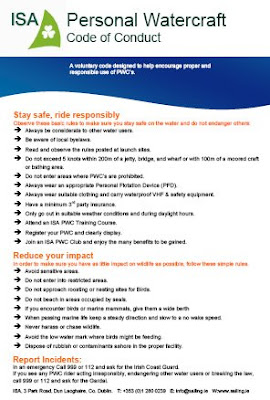
Recently we have seen an increase of Jet Ski use along the river Boyne, and now on the Castletown River in Dundalk. In both locations jet skis were observed speeding and creating significant wake, turning in tight circles, and disturbing wildlife, in particular wild birds that use the two areas for nesting. At Dundalk docks the flock of 40 odd mute swans nest in the salt marsh just adjacent to the quay wall, along with mallard and other species. The area is used by dozens of species for feeding and roosting. The use of Jet Skis in this area should therefore be in strict compliance with the Irish Jet Ski code of conduct. Specifically the item that states: “Do not exceed 5 knots within 200m of a jetty, bridge, and wharf or with 100m of a moored craft or bathing area” and “Never harass or chase wildlife“. The code of conduct also suggests, “If you see any PWC rider acting irresponsibly, call 999 or 112 and ask for the Gardai.“

The areas in question on the Boye and on the Castletown are highly sensitive areas for wildlife, being protected by both national and EU legislation (being SAC, SPA and NHAs). Clearly the entire length of the Boyne inside County Louth and beyond is protected and jet skis should, along with all other watercraft, limit their speed to less than 5 knots. Equally in that part of the Castletown that runs through Dundalk as far as Bellurgan should be have a 5-knot speed limit. The code of conduct is however only a guideline and stronger rules may be needed.
Inland waterways in Ireland are subject to a patchwork of regulations but the pertinent legislation in the context of the Boyne and Castletown are as follows:
1. It is an offence under the Wildlife Act to disturb any bird or other protected wildlife. Generally the NPWS enforce this along with the Gardai.
2. Both port areas are also regulated by their respective Harbour Masters who enforce appropriate speed limits, nominally 5 knots.
Dundalk Harbour Master: 042 9334096
Drogheda Harbour Master: 041 983 8378 http://www.droghedaport.ie/
Inland waterways in Ireland are subject to a patchwork of regulations but the pertinent legislation in the context of the Boyne and Castletown are as follows:
1. It is an offence under the Wildlife Act to disturb any bird or other protected wildlife. Generally the NPWS enforce this along with the Gardai.
2. Both port areas are also regulated by their respective Harbour Masters who enforce appropriate speed limits, nominally 5 knots.
Dundalk Harbour Master: 042 9334096
Drogheda Harbour Master: 041 983 8378 http://www.droghedaport.ie/
The Inland Waterways of Ireland may also be helpful for advice but if people do not respect the code of conduct (and to date compliance is not good) it is tough for the Harbour Master, Gardai or NPWS to enforce the law.
As a consequence the best long-term solution to this growing problem is the passage of Council Bye-Laws. This solution has been successfully adopted by many other local authorities, notably nearby progressive Fingal . The regulatory basis for this is the fact that the Marine Safety Act of 2005 (see below) empowers local authorities to enact these byelaws. Hopefully Louth’s local authorities will take action soon, before the issue become a major problem.
“6.—(1) Bye-laws may be made regulating or controlling the operation of craft or craft of a specified class by—
(a) a local authority, in waters in its functional area, other than waters referred to in paragraph (b) (except where the harbour authority concerned agrees) or paragraph (c),
(b) a harbour authority, in or on waters under its control or management, or
(c) Waterways Ireland, in or on waters under its control or management,
in respect of any or all of the following matters—
(i) the prohibition or restriction in the waters or such part of the waters specified in the bye-laws of the operation generally or for any particular purpose of craft or specified classes of craft in such places or at such times (if any) or for such periods (if any) as specified in the bye-laws—
(I) in the interests of the safety of persons using the waters generally or at certain times,
(II) to prevent nuisance to or injury to persons or damage to watercraft or other property on the waters, or
(III) subject to subsection (7), to protect—
(A) a natural heritage area, or
(B) a monument or wreck protected under the National Monuments Acts,
(ii) matters relating to launching, mooring or berthing craft,
(iii) conditions to be observed by operators of craft with regard to the waters or the adjacent area in which craft are used or launched, or (iv) maximum speed limits at which craft may be operated.”
As a consequence the best long-term solution to this growing problem is the passage of Council Bye-Laws. This solution has been successfully adopted by many other local authorities, notably nearby progressive Fingal . The regulatory basis for this is the fact that the Marine Safety Act of 2005 (see below) empowers local authorities to enact these byelaws. Hopefully Louth’s local authorities will take action soon, before the issue become a major problem.
“6.—(1) Bye-laws may be made regulating or controlling the operation of craft or craft of a specified class by—
(a) a local authority, in waters in its functional area, other than waters referred to in paragraph (b) (except where the harbour authority concerned agrees) or paragraph (c),
(b) a harbour authority, in or on waters under its control or management, or
(c) Waterways Ireland, in or on waters under its control or management,
in respect of any or all of the following matters—
(i) the prohibition or restriction in the waters or such part of the waters specified in the bye-laws of the operation generally or for any particular purpose of craft or specified classes of craft in such places or at such times (if any) or for such periods (if any) as specified in the bye-laws—
(I) in the interests of the safety of persons using the waters generally or at certain times,
(II) to prevent nuisance to or injury to persons or damage to watercraft or other property on the waters, or
(III) subject to subsection (7), to protect—
(A) a natural heritage area, or
(B) a monument or wreck protected under the National Monuments Acts,
(ii) matters relating to launching, mooring or berthing craft,
(iii) conditions to be observed by operators of craft with regard to the waters or the adjacent area in which craft are used or launched, or (iv) maximum speed limits at which craft may be operated.”
Sunday, May 10, 2009
More Poisonings
The lambing season should be coming to an end now yet the apparent national spate of poisoning continues. Framers put out meat or carrion bated with poison to kill foxes who prey on their lambs. The farmers are probably also targeting hooded crows and magpies, since it is widely believed that these species also kill newborn lambs (the evidence for this is scant - in one study (Houston, Report on Hooded Crows and Hill Farming in Argyll, Dept of Forestry and Natural Resources, Edinburgh University, 1968) it was found that about 1 in 1700 lambs were killed by crows. In lowland areas the number is doubtless lower.) Poison is also put out to prevent grey crows from eating recently sown grain (see below).

Buzzard
However the big problem with the indescriminate use of baited meat is that it will also kill any other species that eats it, particularly birds of prey such as the recently returned buzzard. This is proving to be a major problem with the reintroduction of the white-tailed eagle in Kerry and the golden eagle in Donegal. Click here for the petition to regulate the use of poison.
Closer to home, poisoned buzzards were found near Knockbridge, County Louth last week. According to a piece in the Irish Times, "EIGHT RARE buzzards have been killed in suspected poisoning incidents in the northeast in the last two months. The National Parks Wildlife Service (NPWS) said yesterday it was investigating the discovery of buzzard carcasses on farmlands in north Dublin, Louth and Meath. The broad-winged birds of prey have only recently re-established themselves in Ireland after becoming extinct in the early 20th century through poisoning and hunting." According the Dr Maurice Eakin of the NPWS, "the true number of buzzards being poisoned may be far higher, as birds often retreat to secluded spots to die after consuming contaminated food and their deaths may go unnoticed". The article continues, "Experts believe the buzzards may be consuming poisoned bait intended for grey crows which are known to eat recently-sown grain."
Subscribe to:
Posts (Atom)